
Every lift reaches a point where patching up the same faults stops making financial sense. The decision that follows is rarely simple. Do you modernise what you already have, or strip it out and start again? Both routes can be the right answer depending on the lift, the building and your budget, and choosing well can save you thousands of pounds and weeks of disruption. Choosing badly tends to mean paying twice. This guide walks through how to weigh the options properly so the decision rests on the condition of your lift rather than a hunch.
Signs that a lift is reaching the end of its life
A lift rarely fails without warning. Long before it gives out completely, it starts giving you signals, and they tend to come in clusters:
- Callout costs creep up
- Parts become harder to source
- Doors that used to close cleanly start sticking or refusing to align
- The ride gets rougher, slower, or more erratic
- Longer periods out of service become routine rather than the exception
None of these things are trivial, and taken together they paint a clear picture. We’ve gone into more detail on the individual warning signs in our guide to the signs that your lift needs repairs.
It’s worth paying close attention if your engineer has started improvising. Once original components become obsolete, fixes increasingly depend on adapting parts that were never made for your lift. That’s when reliability starts to slip and the cost of individual repairs begins to climb. A lift needing three or four unplanned callouts in a year has almost certainly moved beyond what routine maintenance can handle.
It’s also worth stepping back and asking whether the lift still actually fits the building. One that was specified twenty or thirty years ago was designed around how the building was used then, not how it’s used now. Heavier footfall, changing accessibility requirements, or simply an interior that’s been refurbished around it can all leave a lift looking and feeling out of place. The question isn’t just whether it still works. It’s whether it still does the right job.
What modernisation actually involves
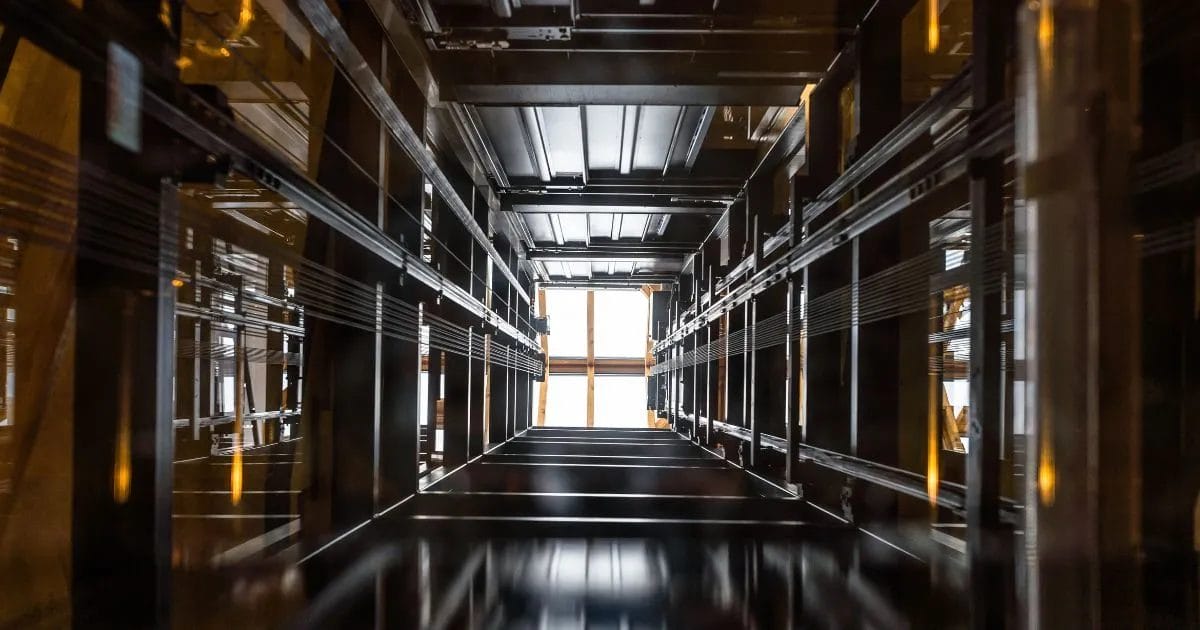
Modernisation, sometimes called refurbishment, works by keeping what’s still structurally sound and replacing what isn’t. The shaft, car frame and guide rails typically stay. What gets renewed is everything that wears out or becomes dated:
- The control system
- The drive
- The doors and door operators
- The car interior
- The lighting
- The safety components
You’re essentially giving the lift a new working heart while keeping the skeleton in place.
The appeal is obvious: done properly, a modernisation can feel indistinguishable from a new lift, at considerably less cost and with far less disruption to the building. Reliability tends to improve sharply because the components most prone to failure have been replaced. Running costs usually fall too; older drives and lighting are often surprisingly inefficient by modern standards. And the lift can be brought in line with current safety requirements without the structural work that a full replacement involves.
Modernisation makes the most sense when the structure of the lift is still fundamentally sound, but the running gear and controls are worn out, or when you need a meaningful improvement in reliability and appearance without taking the lift out of action for an extended stretch. It also gives you the option to phase the work, tackling the most urgent elements first and coming back for the rest when budget allows. For anyone managing several lifts across a portfolio, that kind of flexibility can make a significant difference. Our lift refurbishment service page sets out what a typical overhaul covers.
When full replacement makes more sense
There are situations where modernisation is simply throwing good money after bad. Full replacement is usually the more sensible long-term decision when:
- The shaft itself is in poor structural condition
- The lift fundamentally doesn’t suit how the building is used
- So much of the installation is obsolete that a refurbishment would end up replacing almost everything anyway
A new lift resets everything. You get the longest possible service life, the most up-to-date efficiency and accessibility features built in from day one, and a clean compliance position with full documentation. In buildings where the lift is heavily used and downtime is genuinely costly, that reassurance can justify the higher outlay. Replacement is also the obvious answer if you’re reconfiguring the building and the current lift is in the wrong position or the wrong size for what you need.
There’s a reliability argument too. When you modernise around an ageing structure, you’re placing a degree of trust in the parts you’ve left in place. That uncertainty doesn’t disappear just because you’ve renewed everything around it. A new installation removes it entirely, which is part of why critical settings, hospitals, care homes, high-traffic commercial buildings, often justify the larger spend.
Comparing cost, downtime and lifespan
When it comes to making a final call, three factors tend to dominate: cost, downtime, and expected lifespan. The difficulty is that they often point in different directions.
Modernisation generally costs less upfront and keeps the lift out of action for a shorter time. In occupied buildings, care homes, offices, residential blocks, that matters enormously, because a non-functioning lift isn’t just an inconvenience. Replacement costs more and takes longer, sometimes several weeks, but it gives you the longest possible service life and removes the lingering uncertainty of relying on structural elements you can’t fully inspect.
There’s no single right answer, because two lifts of identical age can be in completely different condition depending on how they’ve been used and maintained. A lightly used lift that’s been well looked after may have years of structural life left, making modernisation the clear choice. A heavily used lift that’s been neglected may be beyond economic repair even if it looks younger on paper. This is also why any recommendation from someone who hasn’t actually inspected the lift should be treated with scepticism.
Getting the timing right
Timing matters just as much as the decision itself. Waiting until the lift has completely failed means making a rushed choice under pressure, usually while users are already stuck without access. Starting the process as soon as the warning signs appear gives you breathing room, time to get multiple quotes, compare options without feeling rushed, and schedule the work at a point that causes the least disruption. It also lets you plan the budget properly rather than having to find a large sum at short notice.
For anyone responsible for multiple lifts, forward planning is even more valuable. Knowing where each one sits in its life cycle means you can stagger the work and the costs, rather than having everything hit at the same time. What would otherwise be a series of nasty surprises becomes a planned, manageable programme of investment.
Modernise or replace? Let us take a look
The most reliable way to answer the question is to have the lift properly assessed before you commit to anything. A thorough survey goes beyond the symptoms you’ve noticed and looks at the condition of the components you can’t see, then gives you realistic figures for both options rather than a rough guess. Our engineers do exactly this as part of our lift inspection service, and we’ll give you an honest view of which route we’d recommend and why. When you’re ready for a proper look at your building, book a survey and we’ll come and see it.
